The ADHD Money Avoidance Cycle (And How to Break It)
You've been avoiding looking at your bank account (again). Not because you don't know it's there, or that you have things you ‘should’ be doing. You know, you really really know! You just can't quite bring yourself to open the app(s). The longer you go without looking, the worse the fear and dread gets. The more you avoid, the more you catastrophize things. Your imagination often runs wild with how bad things are.
And then it happens! Something finally forces your hand: a declined card, a notification you can't ignore, a conversation with your partner that's been building for weeks. And then you do the only thing that makes sense to you.
You go into full panic-fix-hyperfocus mode.
You tell yourself that THIS is finally going to be the time that you get your financial $hit together so you:
open every account
log every transaction
build a colour-coded budget that is, genuinely, a beautiful piece of work
check your balances three times a day
are getting all the dopamine from your hyperfocus mode
And you feel briefly, intensely in control. And then the intensity fades because the dopamine starts to disappear, or life happens that your ‘perfect plan’ didn’t account for. The tracking becomes a chore. The chore becomes something you'll "do later." Later becomes avoidance. And you're back at the beginning (again).
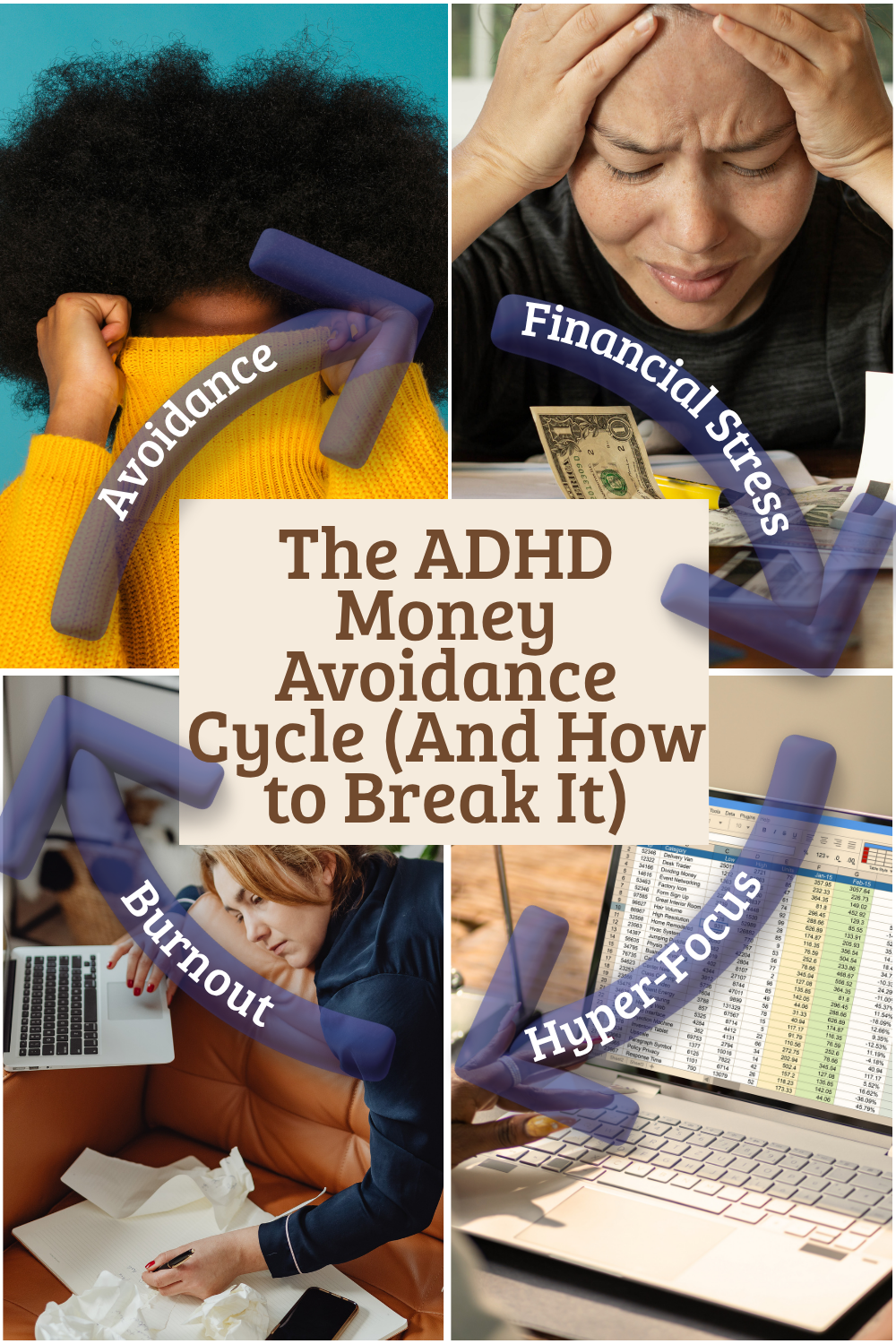
If this cycle sounds familiar, you're not imagining it. It's one of the most common patterns I see in ADHDers trying to make changes with how they manage money: avoid, panic, track every penny ‘perfectly’, burn out, avoid again.
Why Does This Cycle Keep Happening?
Avoidance Is Your ADHD's Coping Mechanism
When something feels threatening or overwhelming (like financial stress), ADHD brains often respond with avoidance. Not because you don't care. Because the emotional weight of looking at the thing feels unbearable, and avoidance is your brain's way of protecting you from a feeling it doesn't know how to manage.
Unfortunately, the problem is that avoiding financial tasks compounds the original problem. Bills don't get paid. Subscriptions keep charging. The pile of unknown information grows, and so does the dread of looking at it. By the time you do look, the numbers are worse than they would have been if you'd stayed on top of things, which reinforces the belief that checking in on your money always feels terrible. So you avoid again.
Shame Makes the Whole Thing Worse
Shame is the part that doesn't get talked about enough. The avoidance isn't only about the task. It's about what the task represents. Checking your bank account means confronting evidence of every spending decision you regret, every automatic charge you forgot about, every time you meant to do better and didn't. For ADHD brains that often carry a lot of financial shame (which is most of us, by the way), that is a LOT to walk into ‘voluntarily.’
This post on the shame spiral and emotional spending goes deeper on why shame is such a core part of the pattern. But the short version: shame doesn't go away when you avoid it. It just gets louder.
The Overtracking Phase Isn't the Solution (I promise!)
When the avoidance finally breaks, the pendulum usually swings hard in the other direction. You track everything obsessively, reconcile accounts, read every transaction, build a custom colour-coded spreadsheet with so many categories that the drop-down menu gets too long to manage!
This feels like the fix. You're doing all the things you should have been doing. Right? Isn’t this what ‘normal’ people do to stay on top of their money? As a financial coach who specializes in helping folks with ADHD, I can’t tell you what the neurotypicals do, but for folks with ADHD, overtracking is exhausting. Add to it that it creates more shame, isn’t sustainable, and most importantly, is not the way you will actually make long-term changes with your money.
Why doesn’t tracking every transaction (or using a fancy app) work for folks with ADHD? It requires a level of sustained attention and repetitive task completion that ADHD brains aren't set up for. Eventually the dopamine of "new system" wears off; it feels like a burden, and you stop doing anything because we tend to have all-or-nothing minds! So you end up back in avoidance mode until…the next thing that forces you back into fix it mode.
How to Actually Break It
Stop Trying to Go From Chaos to Perfect in One Weekend
The biggest mistake I see ADHDers make when they finally face their finances is trying to go from "I haven't looked in six weeks" to "I have a complete and perfect tracking system" in a single sitting. That approach is a very short path to overtracking burnout and ‘I can’t do it perfectly so I may as well not bother’, which leads right back to avoidance.
The goal isn't a perfect system. The goal is a sustainable minimum. I know, I know that’s not how our brains work, but what you’ve been doing hasn’t been working, so let’s think about what the least amount of financial engagement is that can still keep you on track? For most people, that's something like: knowing your approximate bank balance(s), having an idea what your monthly expenses are, having major bills automated so they don't slip, and checking in briefly once or twice a week. That's not glamorous. But it doesn't collapse after two weeks either.
Adding in a second checking account that you use to manage your ‘daily spending’ can make you feel more comfortable with automating some of your bills, and make spending decisions a whole lot easier. My co-host and I talk about our exact account setups in a recent podcast episode, which may inspire you to make some changes.
Make Regular Check-Ins Low Stakes and Add In a Little Joy
Part of what makes the avoidance-overtrack cycle so persistent is that financial engagement tends to happen in crisis moments, which makes the whole experience feel high-stakes and exhausting. What helps is building in low-stakes, regular contact with your money. Not a full audit. Not a budget review. Just glancing at your balance the way you'd check the weather. You're not making decisions. You're just staying aware so nothing catches you completely off guard.
Some folks do this well with a specific recurring reminder, a Sunday morning check-in or a Tuesday lunch habit. Others do better with an accountability structure, or by partnering it with a little sweet treat. The format matters less than the consistency.
Automate to Shrink the Surface Area of Avoidance
Every financial task that has to be done manually is an opportunity for avoidance to take over. Bills paid automatically can't be missed. Savings transferred automatically on payday don't require a decision in the moment. The fewer things your financial life requires you to actively remember and act on, the smaller the pile of things you can fall behind on.
Think about what you can set up to happen automatically so that when (not if) you hit a period where you don’t have the executive function to log into your bank app and pay your bills, they still get paid.
Automating everything at once can feel overwhelming, and can often be the path to failure because you again tried to go from zero to 100. Instead, make a list of all the things you can automate, and start with one thing. Each week, add in one more. Tip: add a recurring weekly reminder that includes your list, or a link to your list, so you aren’t depending on your brain to remember (because it won’t).
Be Honest About the Shame
If your avoidance is being driven by shame, by a belief that what you'll find when you open the app will confirm something terrible about you, that part needs direct attention. Not in a "just be kinder to yourself" way, because that's rarely enough on its own. In a "let's name what's actually happening here" way.
Shame shrinks when it's witnessed. Talking to someone, whether that’s a therapist, a financial coach, a trusted person, or a combination of folks, about what it actually feels like to deal with your money is often more powerful than any budgeting technique.
Where to Start Right Now
If you're currently in the avoidance phase: open your banking app right now. Don't do anything else. Just look. Notice the numbers without making any decisions about them. That's the whole step for today.
If you're currently in the overtracking phase and you can feel the burnout approaching: identify the one or two most essential things to keep doing and gently let the rest go for now. Maybe that’s automating one bill (or setting up a bigger plan to add more automation in), tracking your income, or adding a weekly check-in to your calendar. Everything else waits until you've rebuilt some capacity.
And if this cycle has been going on long enough that you're exhausted and ready to try something new, let’s connect to explore if working together in one of my financial coaching programs is right for you!
About the Author
Sherry is an ADHD financial coach and ADHDer who has worked through her own version of this cycle more times than she'd like to admit. She helps clients build financial systems that stay standing through the hard weeks, not just the motivated ones. Learn more about working with Sherry.