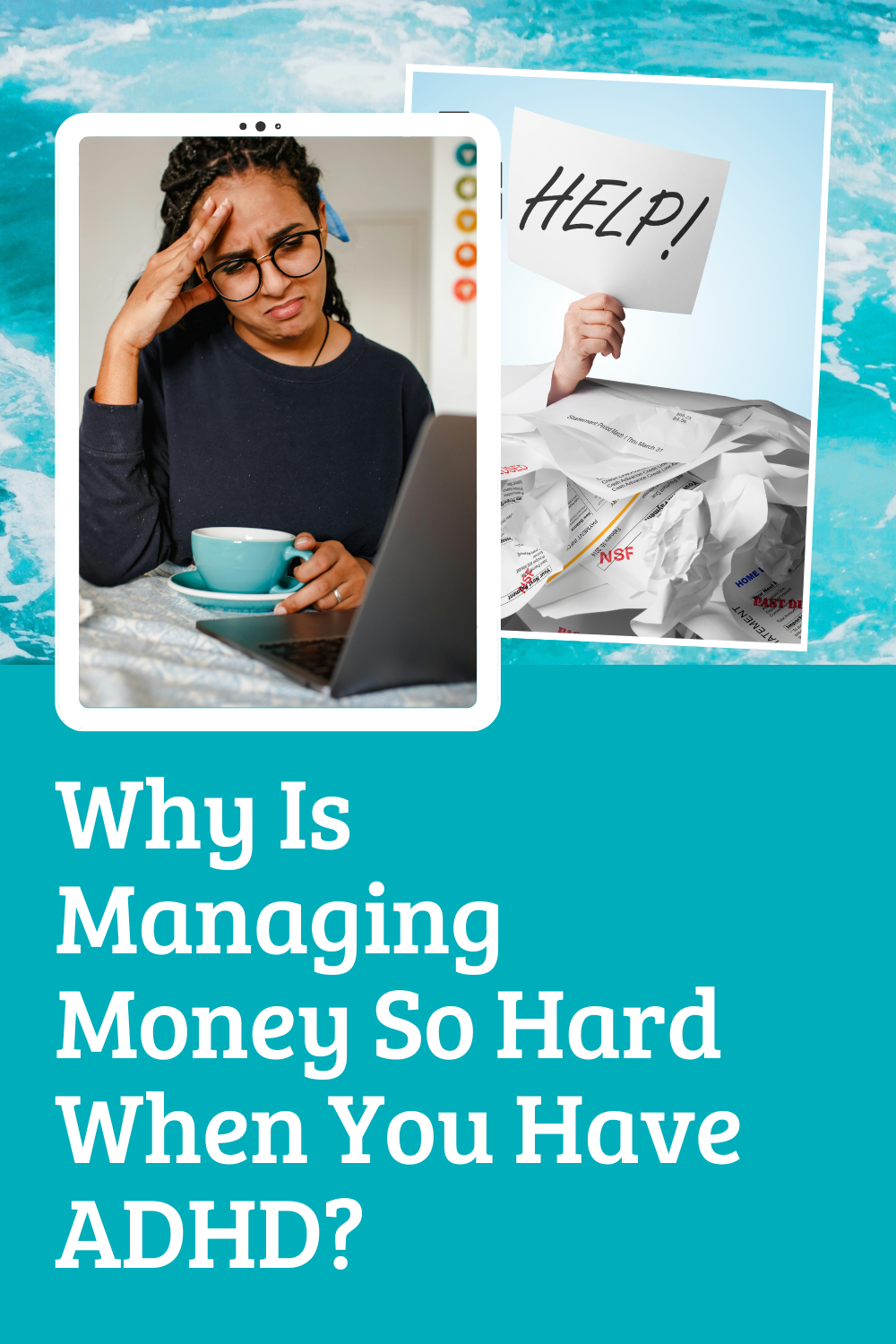
ADHD and Money: Why Do I Ignore My Finances Even When I’m Stressed About Them?
If you have ADHD, you’ve probably had this experience.
You know you should look at your bank account.
You know bills are coming out, and you need to make at least a few manual bill payments.
You know avoiding it is making your stress worse.
But… you still don’t look. Because it’s scary AF!!
Instead, the worry, fears, stress and shame fester! You think about your finances constantly while doing absolutely nothing about them. You might even feel your stomach drop when you think about logging into your bank account. So you don’t. You scroll. You distract yourself. You tell yourself you’ll deal with it tomorrow.
And then tomorrow becomes next week or next month.
If this sounds familiar, let me say this clearly. You are not lazy. You are not irresponsible. And you are definitely not bad with money.
This more common that you think for folks with ADHD and it makes a lot of sense once you understand what’s actually happening in your brain.
Why ADHD and financial avoidance go hand in hand
Money avoidance is not a character flaw. It’s a nervous system response.
For many folks with ADHD, money carries a lot of emotional weight. Shame. Fear. Past mistakes. That “I should know better by now” feeling. When your brain anticipates discomfort, it tries to protect you by avoiding the thing altogether.
Even when avoiding it makes things worse.
Here’s why this shows up so strongly with ADHD
Overwhelm hits fast.
Money is not one task. It’s many tasks layered on top of each other that all seem to need to happen at the same time. Logging in. Remembering passwords. Interpreting numbers. Making decisions. Thinking about future consequences.
That’s a lot of executive functioning. When your brain gets overloaded, it hits the brakes.
Avoidance is the result.
Shame shuts everything down
If you’ve ever missed payments, overspent, racked up debt, or been told you’re bad with money, your brain remembers that. So every time you think about your finances, all of that emotional history shows up too.
Shame is paralysing. It does not motivate action. It creates freeze.
Stress and dopamine don’t mix
ADHD brains are in constant dopamine seeking mode. When something feels boring, scary, or emotionally heavy, your brain looks for relief fast. That’s when scrolling, shopping, snacking, or literally anything else feels easier than opening your banking app.
So even though money stress is loud in your head, your brain avoids the actual task because it feels unsafe and unrewarding.
Why ignoring your finances makes everything feel worse
Here’s the frustrating part. Avoidance gives short term relief, but it massively increases long term stress.
Bills get missed. Late fees pop up. Balances feel bigger because you don’t know the real number. Your brain fills in the gaps with worst case scenarios.
And then the cycle reinforces itself.
More stress leads to more avoidance.
More avoidance leads to more shame.
More shame makes it even harder to start.
This is not a discipline issue. It’s a systems issue.
What actually helps ADHD money avoidance
The goal is not to force yourself to “just deal with it.” That rarely works, and if it does, it’s not sustainable.
The goal is to reduce emotional friction and make money feel safer and simpler to engage with. Really, I want managing your money to feel boring (and it can, it takes time to get there though).
Here are ADHD friendly ways to do that.
Separate your money so it feels less scary
When all your money lives in one account, everything feels urgent and overwhelming. You don’t know what’s safe to spend and what’s already spoken for.
Think of this like going from all your clothes (including your dirty ones) all mixed up in one laundry basket to your clothes sorted and the clean ones folded in your drawers. It feels easier, less stress inducing, and helps your brain get out if fight or flight mode.
It gives your brain instant clarity. Bills money stays untouched. Spending money has clear boundaries. Savings are visible.
Less guessing. Less mental math. Less panic.
If you do one thing after reading this, let it be this. ⬆️⬆️⬆️⬆️
Automate to reduce decision fatigue
Automation removes the need to remember, decide, or rely on motivation.
Bills paid automatically. Money moved to savings automatically. Spending money transferred on a schedule.
Automation is not about giving up control. It’s about protecting yourself from burnout and forgetfulness.
Shrink the task until it feels doable
You do not need a two hour money date, but that can feel overwhelming and increase the friction of getting started (aka task initiation).
Try a five or ten minute block of time instead. That’s it. Set a timer. When it goes off, you’re done….unless you don’t want to be because you’re over the resistance to getting started.
Pair it with something pleasant. Coffee. Music. Sitting outside. Your brain needs positive association, not punishment.
Small steps you can take this week
If money avoidance is your thing, start here.
• Log into your bank account and only look at balances. No decisions. No judgement. Just look.
• Set up one bill to be paid automatically.
• Open one additional account to separate bills $ from spending $.
• Schedule a ten minute weekly money check in on your calendar.
• Write down one money win, even if it’s tiny (like reading this blog all the way to the end).
Small steps matter. Consistency matters more than intensity.
You’re not broken. Your system just isn’t working yet.
When you stop blaming yourself and start working with your ADHD brain, things change.
Money stops feeling like a constant threat and starts feeling manageable. You build trust with yourself. You feel less behind and more in control.
And no, it doesn’t happen overnight. But it does happen.
If you’re reading this thinking, “I get it, but I still don’t know how to set this up,” that’s where support and resources can help. If you’re ready to explore financial coaching, you can learn more about me and coaching by poking around a little here on my website, or you can book a call to chat to see if we are a good fit.
Helping folks with ADHD build money systems that actually stick is what I do. No shame. No rigid budgets. No forcing yourself to be someone you’re not. But, if you’re not ready for one-on-one coaching, I’ve also got a free ADHD Money Starter Kit to help you get started.
I want you to remember this:
Ignoring your finances is not a failure.
It’s a signal that your brain needs a different approach.
And you are absolutely capable of learning one that works.