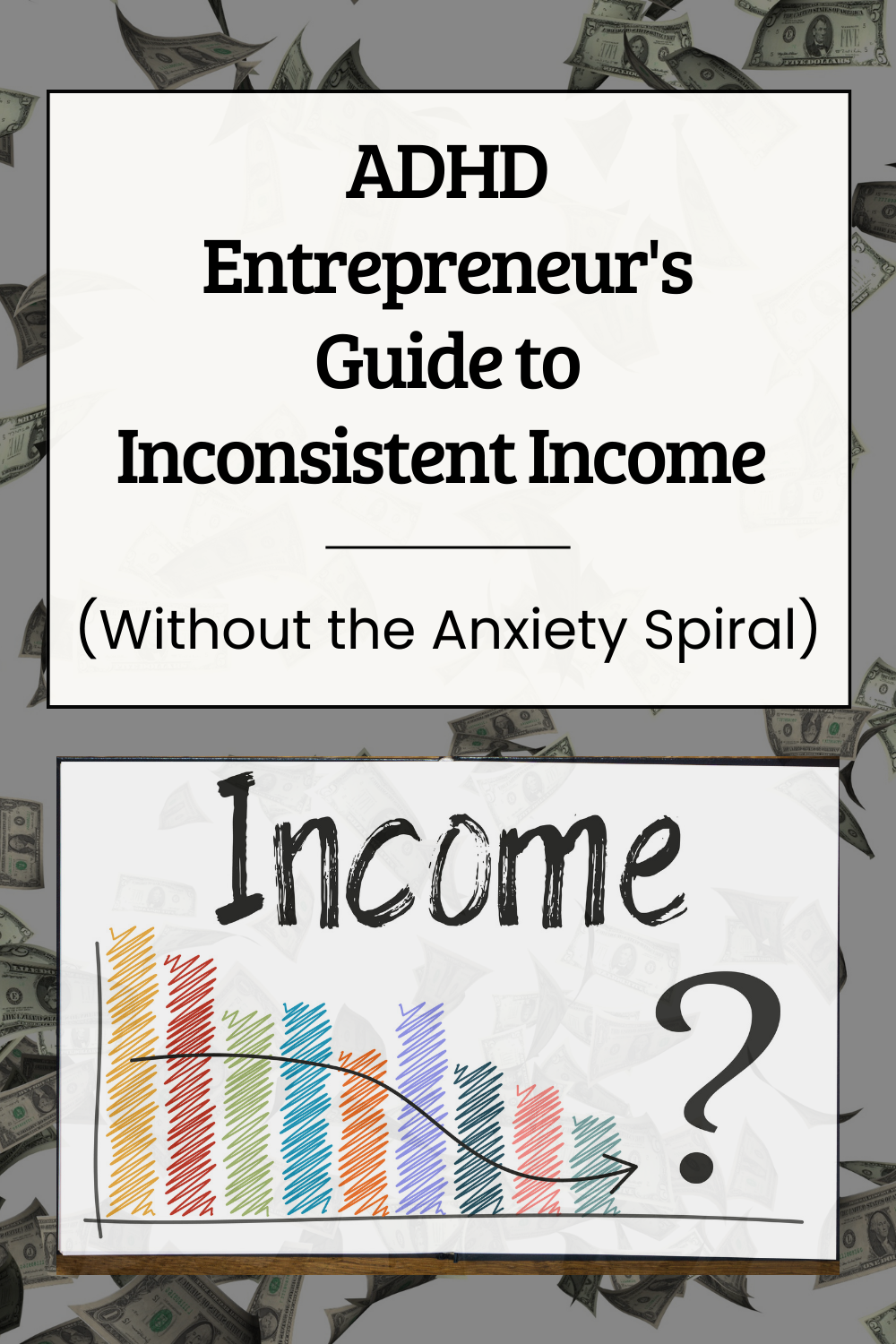
ADHD Entrepreneur's Guide to Inconsistent Income (Without the Anxiety Spiral)
It's the third week of the month and you've booked exactly zero new clients.
Your brain immediately goes into panic mode! The imposter syndrome is hitting hard. You think: This is it. The business is failing. Everyone has figured out I'm a fraud. I should just get a regular job.
And then next month? Five new bookings in one week. Suddenly, you're flush with cash, convinced you've finally figured it out, and you’ll never feel that panic mode from the last month again!
For entrepreneurs with ADHD, dealing with inconsistent income, this rollercoaster probably feels familiar. The feast or famine cycle. The panic when it's slow. The overspending when it's good.
How can you handle the ups and downs without losing your mind?
Why Inconsistent Income Hits Different With ADHD
Inconsistent income and the added pressure of being self-employed are hard for anyone. But when you have ADHD, it triggers a specific kind of chaos and doom spiral.
The Catastrophizing
One slow week becomes "the business is dying." One month with fewer bookings becomes "I'm terrible at this, and everyone knows it."
ADHD brains struggle with perspective. We can't see the full picture. We only see right now. And right now, when things aren’t going our way, it feels like we’ll be stuck here.
The Spending Swings
When income is high, spending goes up. When income drops, panic sets in, but spending can’t always drop with it (especially in the era of a monthly subscription for every new business tool).
Without systems in place, your spending (on the business and personal sides) follows your emotions, not your actual financial reality.
We Go Into Solution Mode
Should you lower your prices? Take on more clients? Panic-market on social media? Pivot your whole business model?
When the anxiety hits, your brain wants to DO SOMETHING. But you can't figure out what. So you either do nothing or do everything at once, and both are recipes for disaster for any business!
How Can You Get Off This Income Rollercoaster?
Understanding Your Business Patterns
Most ADHD entrepreneurs don't: track their income patterns over time.
Because when you're in the thick of it, every slow month feels like a crisis. You don't remember that this happened last March too. Or that December is always slow.
Let's talk about some common seasonal patterns:
Wedding Photographers: Peak season is typically May through October. November through February can be brutally slow. But if you don't plan for that, February feels like a failure instead of the expected seasonality, where you could slow down if you had a clear plan.
Massage Therapists: Often see a surge in November/December as people try to squeeze as much money as they can out of their benefit plans. And many RMT’s work crazy hours and take way less time off for the holidays than they’d like to because they know the demand will decrease come January.
Therapists: May see slowdowns during summer and major holidays when clients are out of routine. January, with resolutions and benefits resetting, and back-to-school in September often brings a surge of new clients.
What are the patterns in your business? When you understand them, slow months stop feeling like emergencies and start feeling like... Tuesday, and can give you time to take time off, work on projects that keep getting put off, or do larger planning in your business.
How to Reduce the Likelihood of Slow Months
You can't eliminate income fluctuations entirely. But, depending on your business, you may be able to reduce how dramatic they are.
Create Longer-Term Offerings
If all your services are one-off sessions or single projects, your income will swing wildly based on how many people book that specific month.
But if you have clients on retainer, monthly memberships, or multi-month packages, you create a more predictable baseline income.
Even if it's just 30-40% of your income coming from recurring revenue, that stability makes a huge difference to your ADHD brain.
Plan For Seasonality
If you know February is slow every year, plan for it.
Save extra in your high months. Launch something in January. Don't schedule expensive business investments for your slowest season.
This isn't about working harder. It's about working with your business rhythm instead of being blindsided by it every year.
I have a few podcast episodes with resources linked that can help you set up systems to minimize the impact of your variable income (and plan for taxes and paying yourself consistently). Check out Part 1 and Part 2.
Diversify Your Income Streams
If all your income comes from one type of service, you're vulnerable to whatever affects that specific thing.
This doesn't mean you need five different businesses. But having 2-3 ways to generate income (one-on-one work, group programs, digital products, workshops) creates more stability.
The Systems That Actually Help
Build a Buffer
The goal here is simple: save enough in your business account to cover 2-3 months of your baseline expenses (the podcast episodes linked above help with taking this a few steps further to create clarity and stability).
This isn't your emergency fund. This is your business operating buffer so that when you have a slow month, you're not in immediate crisis mode.
Yes, this takes time to build. But even having one month's buffer completely changes how a slow period feels.
Pay Yourself a Consistent Salary
Here's the game-changer: stop paying yourself based on what you made that month! Seriously, stop the YOLO-ing in your higher-income months!
Instead, look at your average income and expenses over the past 6-12 months and pay yourself a consistent amount every month.
This does two things: it stabilizes your personal finances AND it removes the emotional rollercoaster of feast/famine.
Separate Business and Personal Spending
When your business account and personal spending are mixed together, you can't see the full picture.
You don't know if you can actually afford that purchase or if you're just reacting to seeing money in the account.
Clear separation creates clarity. And clarity helps you make better decisions when your brain is spiraling.
The Mindset Shift That Changes Everything
The biggest shift isn't about the money. It's about how you think about the fluctuations.
Slow Months Are Not Emergencies
When you have data showing that slow months are part of your pattern, they stop triggering panic.
You can plan for them. Budget for them. Expect them.
A slow month doesn't mean your business is failing. It means it's February.
Your Worth Isn't Tied to This Month's Revenue
This is the RSD piece. When income drops, your brain says: you're not good enough. Nobody wants what you're selling. You should quit.
But slow periods aren't about your value. They're about timing, seasonality, marketing cycles, and a dozen other factors that have nothing to do with whether you're good at what you do.
Action Steps to Take This Week
Review your income for the past 12 months - Look for patterns. When are your high months? When are your slow months?
Calculate your average monthly profit in your business- Add up the past 6-12 months and divide. Use this info to start planning to pay yourself a consistent salary.
Start building a one-month buffer - Even if it's just $100 this month. Start the habit.
Identify one longer-term offering you could create - What service could you package as a 3-month, 6-month, or ongoing engagement?
Separate your business and personal accounts - If you haven't already. This is foundational and has so many positives!
Need Help Building These Systems for Your Business?
If you're an ADHD entrepreneur struggling with inconsistent income and you have no idea how to set up these systems, or what you even need to pay yourself to cover your personal expenses, that's exactly the work I do with my one-on-one financial coaching clients.
We build business money systems that work with your unique brain and business! Systems that create stability, reduce anxiety, and help you actually see the full picture.
Want to learn more? Book a free consultation and let's figure out what better money systems would look like for YOUR business.
Not ready to invest in yourself? My free ADHD Money Starter Kit includes resources that can help you start to build clarity around your personal numbers (and scroll back up for the podcast links to help you with the business side of things).
Remember: inconsistent income is part of entrepreneurship. The anxiety spiral doesn't have to be.